An Interactive
The Exposure Triangle
Aperture, shutter, ISO. Three dials, one budget of light. Drag them and watch a photograph change its mind.
Every photograph is a negotiation. The film (or sensor) needs a certain amount of light to make a correct picture — too little and it’s a muddy underexposure, too much and the highlights blow out to white. You have exactly three ways to control that light, and the catch is that each one changes something else about the image. That trade-off is the whole craft. Photographers call it the exposure triangle.
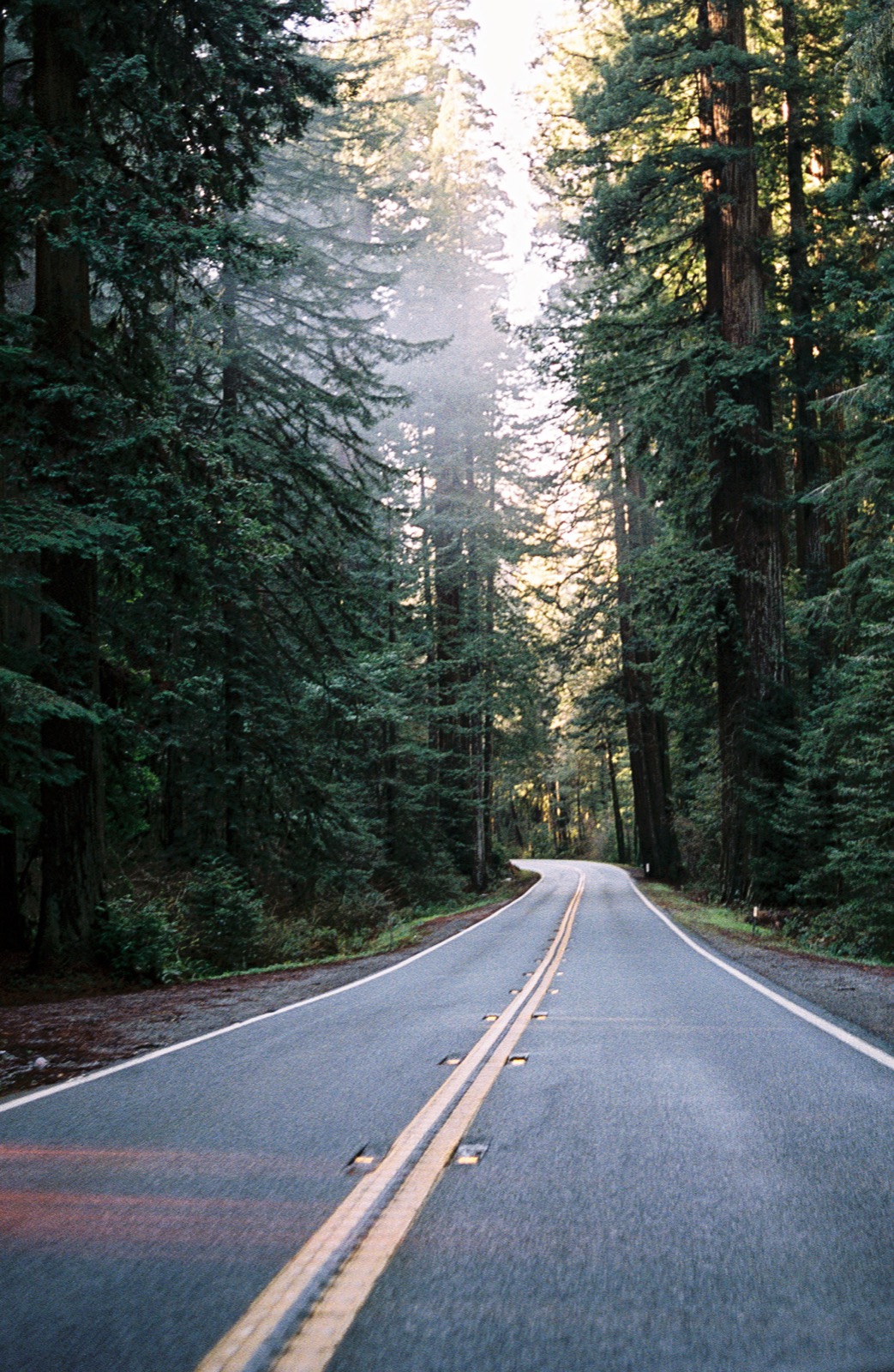
Here’s a frame I shot on a road through the Oregon redwoods. Move the three dials below and watch what each one costs.
Dial one
Aperture — depth
Aperture is the size of the hole the light comes through, written as an f-number. The confusing part: smaller numbers mean wider openings. f/1.4 is a bucket; f/16 is a pinhole. Open it up and you let in a flood of light — but you also shrink the slice of the scene that’s in focus. That’s why a portrait at f/1.4 melts the background into a creamy blur, and why a landscape shooter stops down to f/11 to keep the whole valley sharp. On the road above, watch the redwoods at the edges soften as you open up, while the center holds.
Dial two
Shutter — time
Shutter speed is how long the window stays open. A fast shutter (1/1000s) freezes a hummingbird mid-beat; a slow one (1/15s) lets light pile up but turns anything moving — or any shake in your hands — into a smear. It’s the most physical of the three: you can feel the trade between gathering light and holding still. Slow this dial down and the frame starts to drag.
Dial three
ISO — sensitivity
ISO is how hungry the film or sensor is for light. Crank it and you can shoot in near-darkness without touching the other two dials — the cost is grain (on film) or noise (on a sensor), that gritty texture that creeps into the shadows. ISO 100 is glassy and clean; ISO 3200 is a snowstorm. Sometimes that grain is the look you want. Often it’s the tax you pay for shooting after sunset.
The triangle
Reciprocity
Here’s the trick that ties it together: the three dials are interchangeable units of light. Open the aperture one stop and you can speed the shutter one stop to match — same brightness, but now with shallower focus and frozen motion. Every exposure is one of infinitely many that hit the same total. That’s the meter above: it doesn’t care how you spend the light, only that the budget balances.
So a photograph isn’t really a picture of a place. It’s a record of three decisions about light — how deep, how fast, how clean — made in the half-second before the shutter fell. Try to land the meter back on balanced using a completely different set of dials than the default. There’s no single right answer. That’s the whole point.